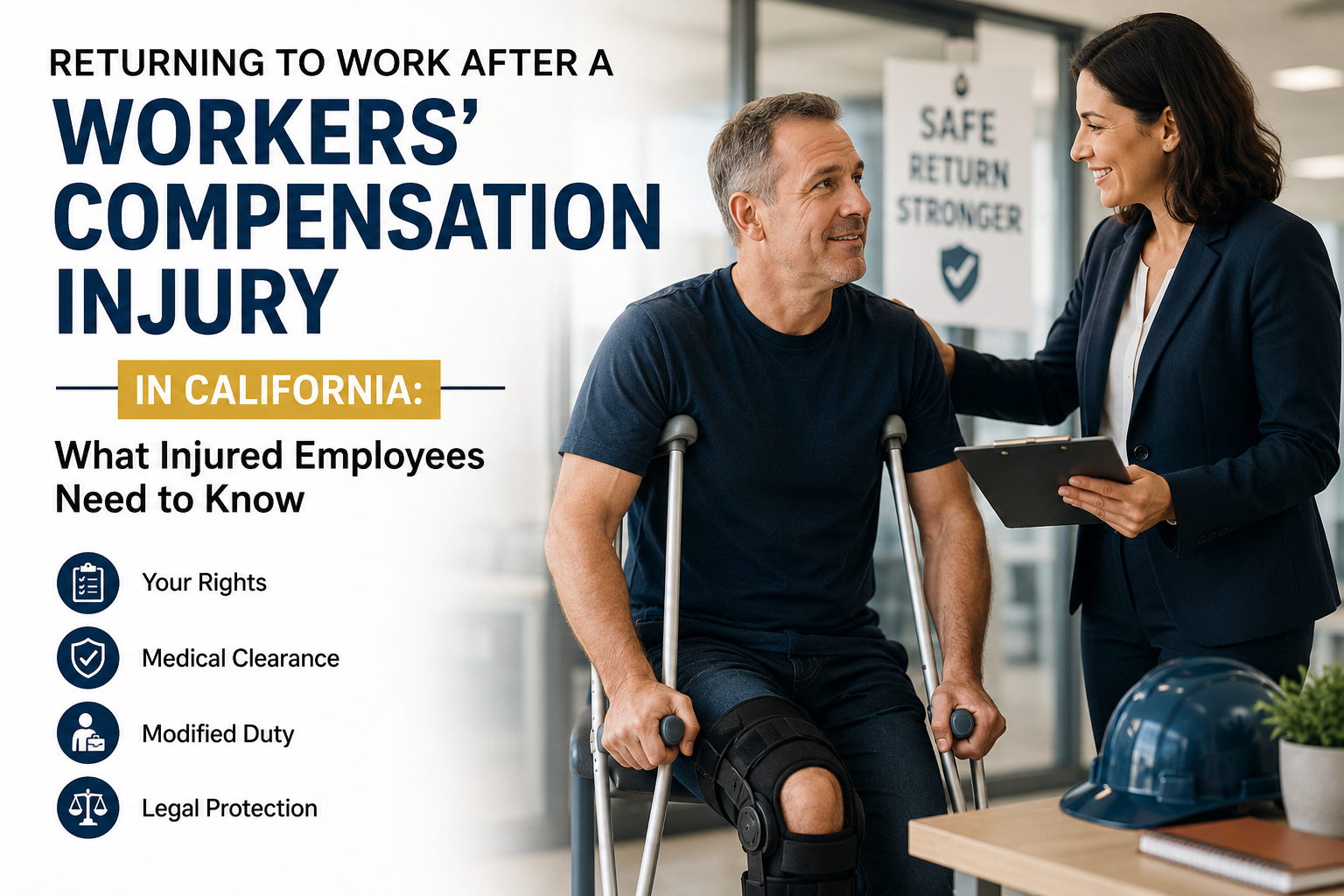
If you’ve been hurt on the job, one question almost always comes up first: “When can I go back to work?” The honest answer is — it depends. Your return-to-work timeline hinges on your specific injury, how your recovery is progressing, and the work restrictions your treating physician puts in place.
Not sure where your claim stands? Talk to a workers’ comp attorney today for a free case review.
Report the Injury and Start Treatment Right Away
The return-to-work process begins the moment you’re injured. Reporting a workplace injury promptly and getting into treatment with an authorized physician sets the foundation for your entire workers’ compensation claim. Your treating doctor will assess your condition and issue a work status report that falls into one of three categories:
- Full duty — cleared to return to work with no restrictions
- Modified or light-duty work — cleared to return with specific limitations
- Temporarily totally disabled — not yet able to work in any capacity
Temporary Disability Benefits and Modified Duty
If your doctor takes you off work entirely, you may qualify for Temporary Disability (TD) benefits to help replace lost wages while you heal. If you’re cleared to return with restrictions, your employer may be required to offer modified duty or light-duty work that fits within those medical limits — a critical piece of California’s workers’ comp return-to-work rules.
Reaching Maximum Medical Improvement (MMI)
As your treatment progresses, your condition should continue to improve. At some point, your physician will determine that you’ve reached Maximum Medical Improvement (MMI) — also called Permanent and Stationary (P&S) status. This is the point where your doctor evaluates whether you’re left with any permanent work restrictions or permanent impairment from the injury.
What Happens After MMI: Permanent Restrictions and Retraining Benefits
Every case resolves differently after reaching P&S status:
- Some injured workers return to their regular job duties with no lasting restrictions.
- Others return with permanent work restrictions that limit certain tasks.
- Some are unable to return to their previous occupation at all.
If you can’t go back to your prior job due to permanent restrictions, you may be entitled to a Supplemental Job Displacement Benefit (SJDB) voucher. This voucher helps cover the cost of retraining or education so you can transition into a new career path.
The Bottom Line
No two workers’ compensation cases are identical. The best way to protect your return-to-work rights is to follow your doctor’s treatment plan, attend every medical appointment, and stay in close communication with your employer about your work status and restrictions. Understanding each stage of the California workers’ comp process — from the initial injury report through TD benefits, MMI, and potential SJDB eligibility — can ease uncertainty and help ensure you receive every benefit and protection you’re entitled to under California workers’ compensation law.
If you’ve been injured at work and have questions about your rights, temporary disability benefits, or return-to-work options, speaking with an experienced California workers’ compensation attorney can help you understand your next steps.
Have Questions About Your Return-to-Work Rights?
Navigating light-duty assignments, TD benefits, MMI, and SJDB vouchers can be confusing — especially while you’re focused on recovering. Our California workers’ compensation attorneys are here to help. Contact us today for a free, no-obligation consultation, and let us make sure your rights are protected every step of the way. Please call RP Law Group at (951) 446-1599.